
Cary Open Records by Custodian
Cary does not keep one master record room. Town departments hold council, permit, planning, annexation, contract, and releasable police material. Wake County holds most local land and tax files, but western Cary reaches Chatham County and a very small part of town lies in Durham County. North Carolina clerks of Superior Court keep court and estate files. State agencies publish several broad searches.
| Records | Official keeper | Web coverage | Other access |
|---|---|---|---|
| Deeds, liens, plats | County Register of Deeds | Wake Self-Service and historical books into the 1700s | Office copies and certification |
| Property and tax | County tax office and GIS | Current Wake Real Estate Search and iMAPS | Phone, office, or a narrow data request |
| Court and estates | Clerk of Superior Court | Statewide eCourts docket data | Public terminal, file inspection, copies |
| Birth, death, marriage | Register of Deeds or N.C. Vital Records | Request portal, not a universal name index | Counter and mail subject to eligibility |
| Permits and annexations | Town of Cary or county | Cary portals and open data | 311, email, or online case |
| Custody and registry | Wake Sheriff, DAC, and SBI | Active official tools vary by record | Agency records unit and court file |
Access is record-specific. Public indexes can omit sealed or expunged cases, juvenile and adoption material, protected addresses, personal identifiers, and criminal investigation records. A portal result is a locator, not always the complete official file. When an online path ends, use the listed office, public terminal, request form, mail channel, library, or State Archives collection that serves that series.
Cary Records Under Chapter 132
North Carolina Public Records Law defines public material broadly, including paper and electronic items made or received in public business. Section 132-6 grants inspection at reasonable times and copies as promptly as possible. It does not set a fixed number of business days. An agency may provide existing online access, and it does not have to create a report or compile data that does not exist.
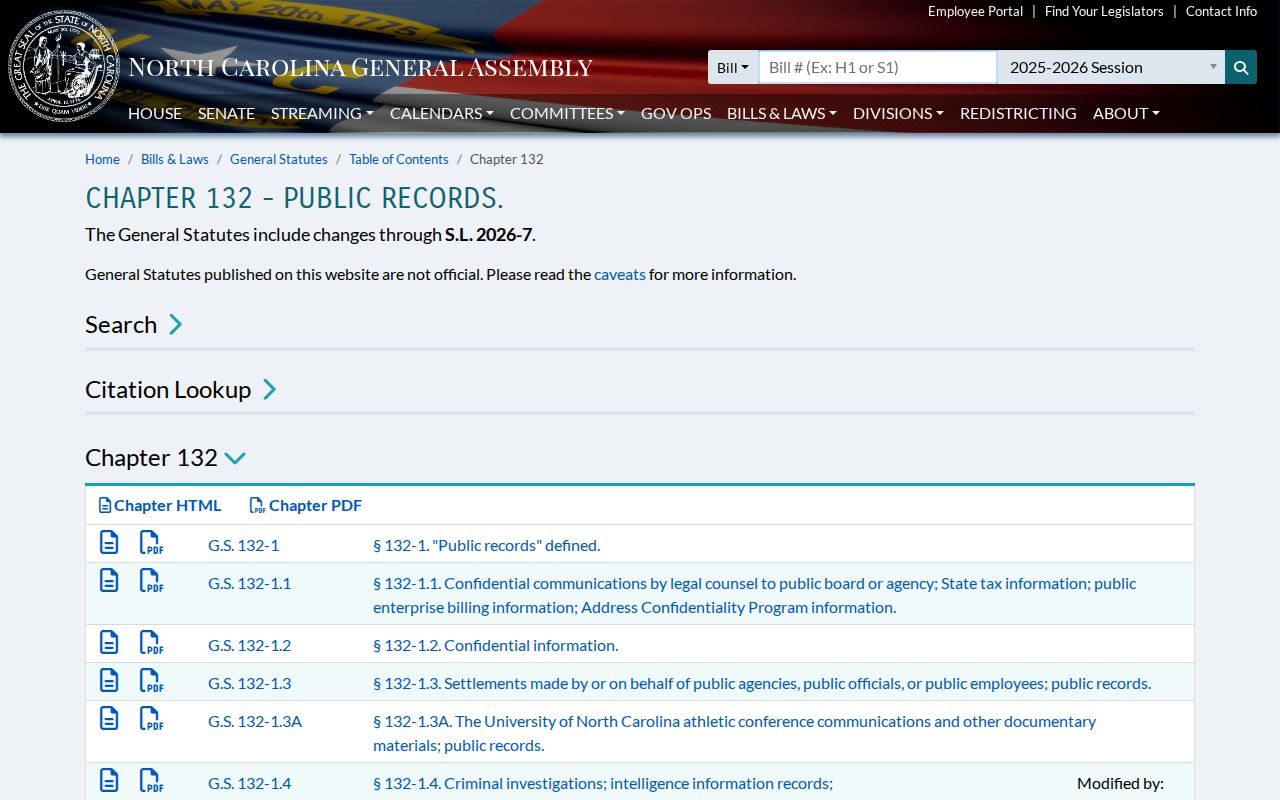
The statute index shown here is the sound starting point for current section text. Section 132-6.2 limits ordinary uncertified copy charges to actual reproduction cost, though extensive technology or staff work may support a reasonable actual-cost service charge. A denial must identify its legal basis, and a requester may ask for that reason in writing. Court enforcement is available under Section 132-9.
Cary Records Cross County Lines
A Cary mailing address does not settle jurisdiction. Wake County contains most of town. Chatham County covers part of western Cary, while town property also touches a very small Durham segment. Cary reports no residents in that Durham portion at present, but Durham can still matter for a parcel. Check the tax bill, GIS boundary, parcel card, or voter profile before selecting an office.
Choosing the wrong county can hide several trails at once. Each county has its own Register of Deeds, tax system, GIS, and Clerk of Superior Court. Cary is not a county seat, so Town Hall does not issue deeds, keep estate files, administer voter registration, or certify vital events. Wake searches should usually come first, followed by Chatham for western addresses and Durham when mapped boundaries require it.
Note: The county tied to the land or event controls, even when the postal city still reads Cary.
Cary Deed Records and Indexes
The Wake Register of Deeds Self-Service search covers deeds, deeds of trust, liens, plats, powers of attorney, assumed names, and related instruments. The Register describes the index as a library-card catalog. Search spelling variants and then inspect the actual document image. Its consolidated historical index reaches eighteenth-century deed books, while the newer system accepts party, instrument, recording-date, and book or page criteria.
| Wake search control | Input | Use |
|---|---|---|
| Party or name | Person or organization | Try surname variants and each indexed party |
| Instrument criteria | Document type or identifier | Narrow a known filing |
| Recording date | Date or range | Limit broad name results |
| Book and page | Volume locator | Open a parcel-card deed reference |
Older records have other routes. The consolidated index offers grantor, grantee, unique-name, and specialized searches, with images where available. Grantor means the party transferring an interest; grantee means the recipient. For an office request, provide the instrument number or book and page and say whether a plain image or certified copy is needed. Chatham-side Cary records instead go through the Chatham Register in Pittsboro.
Cary Property Records Map Ownership
Wake Real Estate Search accepts an owner, street, Real Estate ID, or parcel number. A parcel card can show the owner, mailing and situs addresses, values, legal description, subdivision, building traits, deed book and page, and transfer history. Situs is the physical parcel address. The mailing address is where tax notices go, so the two fields answer different questions.
The Wake County and Raleigh iMAPS viewer adds parcel boundaries, aerials, districts, and jurisdiction layers. It can also link back to deed and assessment details. If a full address fails, try the street alone, directional abbreviations, parcel ID, or map selection. GIS is evidence of government parcel data, not a land survey. Historical tax cards or unpublished datasets may require a request by parcel ID and tax year.
Cary Court Records Beyond Portal
North Carolina completed statewide eCourts conversion on October 13, 2025. Cary matters can appear in Wake, Chatham, or Durham District and Superior Courts, based on the filing and its venue. The statewide Portal locates newer public docket data. It does not make Cary a municipal court jurisdiction, and it does not place every paper file or document image online. The Wake County courts page identifies the local clerk offices and court channels.
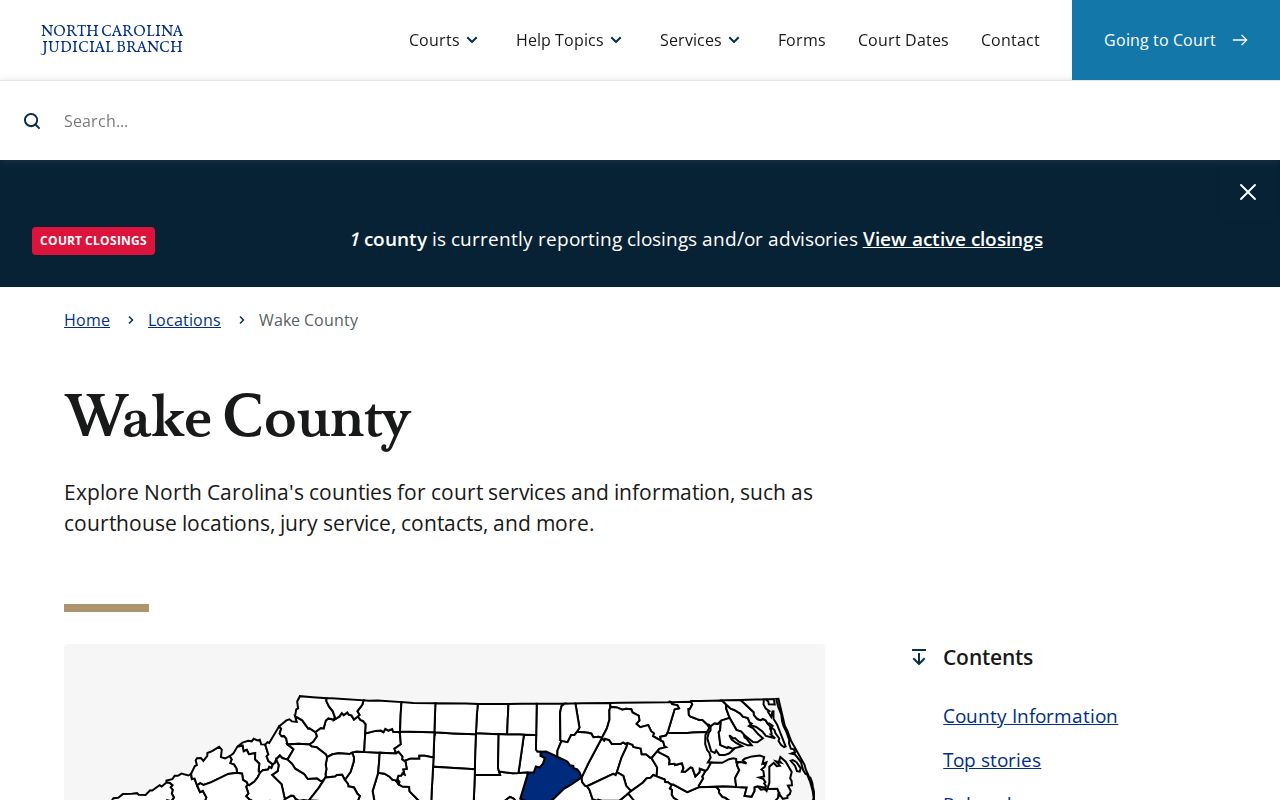
The office listing is the route for local case files, copies, certified documents, estates, wills filed after death, guardianships, and special proceedings. A docket, meaning the case event list, may display parties, roles, status, hearings, filings, and dispositions without providing every document.
NCCourts explains the web, terminal, and file-inspection routes for court material.
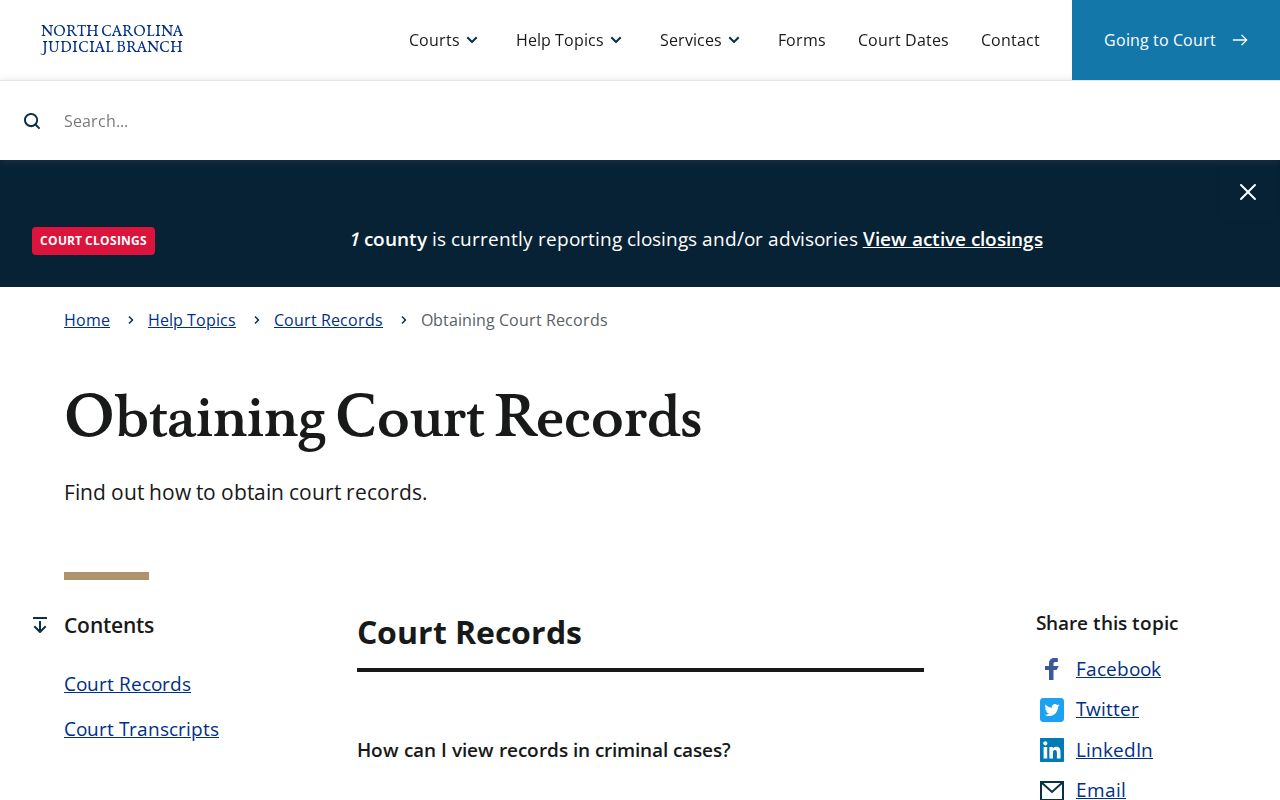
A clerk terminal can search public criminal matters by defendant, case number, or victim or witness name, subject to protection and redaction. Civil, estate, and special-proceeding data are also available at terminals. Take the county, case number, party names, year, and requested document title to the clerk. Older cases may need paper retrieval or an archives check.
Cary Vital Records Copy Rules
Birth, death, and marriage certificates come from the Register of Deeds for the event county or from N.C. Vital Records for a statewide search. The state began statewide registration in 1913 and holds marriage certificates from 1962 forward. A divorce judgment stays with the county Clerk of Superior Court; the state divorce certificate is only an event summary.
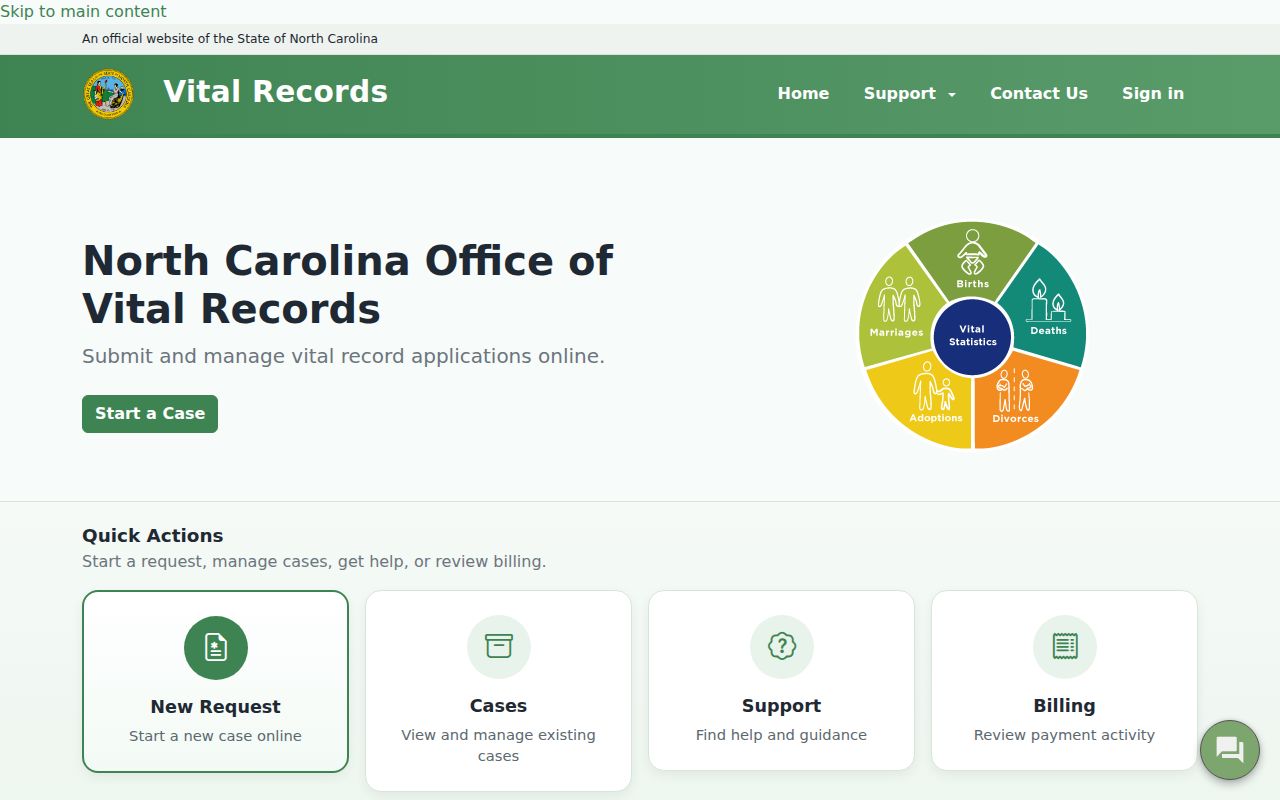
The service portal shown here starts a state request, but eligibility and fees still apply. Under N.C.G.S. §130A-93, certified copies may go to the named person, a spouse, sibling, direct ancestor or descendant, qualifying step-relative, authorized representative, or a person establishing personal or property rights. Wake charges $10 per certified birth, death, or Wake-issued marriage copy. State search fees are generally nonrefundable.
North Carolina law has no simple statewide rule that all births open after 100 years or deaths after 50. Historical research instead moves through State Archives county guides, delayed-birth series, newspapers, churches, cemeteries, and probate files. Adoption records remain sealed under Chapter 48. Uncertified copies can be available with required redactions, but they do not serve every proof need.
Cary Records Offices and Portals
Start with the office that made or keeps the record. Cary Records handles Town business, while county and state custodians control land, tax, court, and certificate files. Portal links may answer a basic inspection need. Contact channels matter when a certified copy, older file, or nonposted existing record is required.
Town of Cary Records
Town departments and Cary Police requests
311 or 919-469-4000
Wake Tax Administration
301 S. McDowell St., Suite 3800, Raleigh
919-856-5400
Wake Register of Deeds
Wake land instruments and certificates
Counter and mail service
Wake Tax Administration publishes weekday hours of 8:30 a.m. to 5:15 p.m.; confirm before visiting. For Chatham-side or Durham-side land, use that county's Register, tax office, GIS, and clerk. A court administrative records form is not a substitute for asking the local clerk for a case file.
Cary Custody and Registry Records
Wake Sheriff resources cover detention, arrests, and releasable incident facts. Publication channels can change. Local reporting on July 22, 2026 said Wake planned to end online mugshots and daily arrest reports in August because the separate system did not receive reliable automatic expunction updates. The Sheriff records unit and eCourts remain distinct official routes when a web publication disappears.
The N.C. Department of Adult Correction search covers state prison, probation, and parole identities and status, not a complete court history. The SBI registry supports official name and geographic searches. Charges are accusations, not convictions, so use the clerk's disposition to resolve an outcome. Cary Police requests go through 311 with the incident number, date, location, and parties when known.
Lawful personal use. Public access never permits stalking, threats, intimidation, or harassment. Registry warnings and North Carolina law apply even when a name or address is easy to find.
Cary Records Fees and Formats
Inspection and an uncertified electronic copy can cost less than certification. Chapter 132 permits actual reproduction cost for ordinary copies. Cary's current policy also allows actual mailing cost and a reasonable special service charge when a request needs extensive staff or technology work. Ask for an estimate and its basis before authorizing extensive work. Database requests may be required in writing.
- Index
- A finding aid that points to a file or image, not the full underlying record.
- Certified copy
- A copy authenticated by the custodian for a formal proof need.
- Custodian
- The agency or official responsible for keeping and providing the record.
- Exemption
- A statute that closes or limits material otherwise covered by access law.
State vital searches can keep the search fee even when no record is found, and vendor or expedite charges may add cost. Court copies and certifications use statutory fees. A Register request should distinguish a portal image, certified instrument, and certified vital certificate. These products have different rules. Save the portal identifier before calling or visiting.
Closed and Redacted Cary Records
Chapter 132 does not erase specialized confidentiality laws. Sealed and expunged cases, juvenile proceedings, adoption material, protected voter identifiers, qualifying Address Confidentiality Program data, personnel files, and some criminal investigation records remain closed or limited. N.C.G.S. §132-1.10 protects specified Social Security and financial account data. DMV personal information is governed by separate federal limits.
A person seeking correction should identify the original custodian and exact document. Determine whether the problem is an incorrect index field, protected identifier, protected address, or lawful but unwanted information. Use the custodian's correction or redaction process and cite the case, parcel, document number, or book and page. Source correction may not erase the historical instrument, but it can add a correction or amend an index.
Note: An empty web result does not prove that no record exists; paper files, redactions, and archive transfers can change what appears online.
Cary Records Alerts and Solicitations
Wake County offers a free Document Recording Alert that monitors recorded names.
The alert screen shown here is a monitoring aid, not title insurance or final proof of fraud. Compare any notice with the actual Register instrument and property record. High-priced deed-copy mailers can quote accurate public details yet still charge far more than the official copy route. An authentic name, deed number, or address does not prove that a sender represents the county.
Find the office through its official government page before calling. Check the document number, owner spelling, and parcel address, then ask whether an image is already viewable or cheaply certifiable. Preserve the letter, envelope, URL, and payment demand when reporting suspected impersonation to Cary, the Register, Sheriff, N.C. Attorney General, or the appropriate federal fraud channel.
Request Cary Public Records
Any person may ask a North Carolina custodian to inspect or copy an existing public record. Cary accepts Town requests by email at 311@carync.gov, by dialing 311 inside town or 919-469-4000 outside, and through its online service case. No special legal phrase is required. Clear scope helps the office locate responsive material and avoid needless labor charges.
- Confirm the town, county, or state custodian. For land or local court files, resolve Wake, Chatham, or Durham first.
- Search the official index and save the case number, parcel ID, book and page, instrument, permit, or other locator.
- Ask for an existing series with names, spelling variants, dates, department, address, and desired electronic or paper format.
- Request a cost estimate when extensive service is proposed. State whether inspection, a plain copy, or certification is needed.
- If access is denied, ask for the legal basis in writing. Narrow an overbroad request without giving up the relevant record series.
Use the clerk's terminal and file counter for court cases, Register forms and counters for land instruments or county certificates, and the library or State Archives catalog for older series. Archives and library inquiries work best with a collection title, box, volume, or call number. Chapter 132 says access must be as prompt as possible, but volume, legal review, medium, and off-site storage affect timing.