
Find People Across Cary
Start with the fact already known. A full name works in the Wake property roll, North Carolina voter lookup, state court search and business registry. An old address works better in the parcel map, deed chain and reverse directories. A phone number may identify an office or public role, but it should be checked against a dated official entry before two similar names are treated as one person.
Cary is not its own records county. Most local trails sit in Wake County, western parcels can sit in Chatham County, and a small part of town reaches Durham County. The county on a parcel, tax bill or voter profile controls the deed office, court clerk, elections board and local certificate desk. That one check prevents a false no-result.
- Confirm the county with a parcel map, tax record or voter profile.
- Search the owner roll or voter record with name variants.
- Use a parcel, case or voter number to separate namesakes.
- Open the deed image or court file behind the index entry.
- Use the library, archives or a narrow records request when the web trail ends.
Cary People Records Offices
The Wake County Register of Deeds keeps recorded land instruments and Wake-issued marriage and vital certificates. Wake Tax Administration links owners to parcels, mailing addresses, values and deed references. Clerks of Superior Court keep civil, criminal, estate, special-proceeding and divorce case files. Cary Records Management handles records made by Town departments, such as council files, permits, planning cases, annexations and releasable police material.
Those duties do not move to Town Hall because a street uses a Cary postal address. Chatham-side records go to Chatham offices. Court cases use North Carolina's state court system because Cary has no municipal court. Detailed copy rules and request routes appear with the Cary public records system.
Search Cary Owner Records
The Wake County Real Estate Search accepts an owner, street, Real Estate ID or parcel ID. An owner result can show the titled owner, tax-mail destination, situs address, deed book and page, legal description, assessed values and transfer information. Situs means the physical property address. The mailing address is where the tax office sends correspondence, and it may belong to an owner who lives elsewhere.
Use the record as a dated lead. A recent deed may not yet appear in the tax roll, and an entity or trust name may replace a person's name. The official property screen shows the details that can turn an address into a stable parcel number.
The Wake owner and parcel search is shown here:
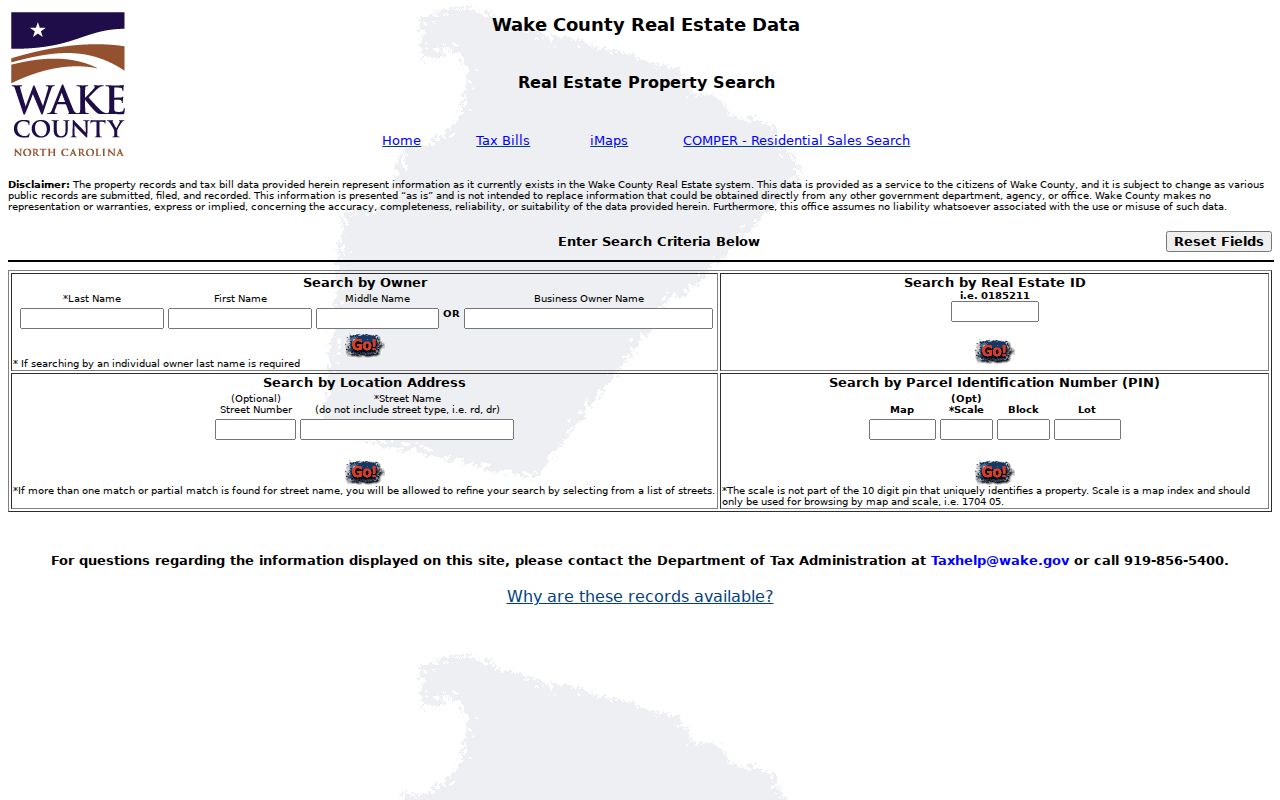
The captured search page helps distinguish an owner-name query from an address or parcel-ID query before following the deed reference.
| Search input | Best use | Key result |
|---|---|---|
| Owner | Find parcels tied to a surname or entity | Owner and mailing address |
| Street | Resolve an old or current address | Situs and parcel identity |
| REID or PIN | Return to one exact parcel | Deed book and page |
Note: If Wake returns nothing, map the address and try Chatham records before deciding that no public owner record exists.
Trace Cary Deeds by Name
Take the deed book and page from the parcel card to the Wake Register of Deeds Self-Service Search. The modern index supports party, instrument, recording-date and book or document routes. Search each spelling variant. The Register compares its index to a library catalog because the index points to the instrument but does not replace it.
The deed image identifies grantors and grantees, the property description and later references. A grantor transfers an interest. A grantee receives one. A deed of trust uses different roles and does not prove current title, so return to the vesting deed before making an ownership claim.
The Wake deed index entry screen provides the bridge from a Cary parcel to its recorded instrument.
The screen is most useful after the parcel record supplies a book, page, party name or recording date.
- Index
- A finding aid that points to a filed record.
- Grantor
- The party transferring an interest in the instrument.
- Grantee
- The party receiving the stated interest.
- Book and page
- The volume locator used to retrieve a recorded image.
Cary Names in Historic Records
Wake's Consolidated Real Property Index reaches eighteenth-century deed books and supports book, page, party and unique-name research. Its Enslaved Persons Search is especially important. At inspection, that official project held 2,156 references and exposed names embedded in deeds that a normal grantor and grantee index would not surface.
Results include a record ID, date, book, page, document identifier, indexed parties and the names transcribed from the instrument. The document identifier connects the entry to the image where available. Variant spelling and incomplete historic indexing still require review of the whole deed.
The historical Wake deed system preserves the search route used for old Cary-area names.
This research route can recover relationships and locations that a modern owner search cannot reach.
Monitor Cary Deed Records
Wake County offers a free Document Recording Alert for names indexed in newly recorded material. An enrolled user chooses the names to watch and receives notice when the Register's system finds a match. The alert can flag a filing early enough for the named person to inspect the instrument and contact the proper office if something looks wrong.
The service is supplemental. It does not stop a document from being recorded, decide whether a signature is valid or prove title fraud. Common names can also produce harmless matches. Open the indexed instrument, compare its document number and property description, then contact the Register or a qualified professional through an independently verified channel. High-priced deed-copy letters and urgent property-fraud pitches should be checked against the same official record before any payment is sent.
Note: The Wake alert watches recorded names, while the deed and parcel records remain the sources used to verify ownership and filing details.
Search Cary Court Records
North Carolina's statewide eCourts Portal now covers all counties. Search a party name or case number, then narrow to Wake or Chatham. A public docket can show the case number, county, type, status, filing date, party roles, hearings, events and disposition. Document images are not uniform online. The clerk's terminal and underlying file remain the fallback.
A public self-service terminal can search criminal matters by defendant, case number, or victim or witness name, with legal protections still applied to released content. Civil, estate and special-proceeding data are also available at terminals. Sealed, expunged, juvenile and adoption matters are not ordinary public results. An absent portal result does not prove that no case exists.
| Record route | Cary coverage | What to keep | Fallback |
|---|---|---|---|
| eCourts Portal | Wake, Chatham and Durham | Case number and party role | Clerk terminal |
| Superior Court clerk | County of filing | Named docket document | Archived retrieval |
| PACER | Federal cases | Court and docket number | Federal clerk |
Choose Cary Vital Records
Birth, death and marriage certificates may come from the Register of Deeds in the event county or from North Carolina Vital Records. The state registers births, deaths, fetal deaths, marriages and divorces. A divorce judgment, however, comes from the Clerk of Superior Court where the case was granted. The state certificate is only an event summary.
North Carolina law limits certified copies to the person named and specified relatives, agents or people who need the record to determine personal or property rights. Uncertified copies can be released with required redactions. There is no simple statewide rule that opens every birth after one fixed age and every death after another. Historical indexes, archives, church registers, newspapers and probate files grow the trail, but they do not change certificate eligibility.
The North Carolina Vital Records service page shows the statewide starting point.
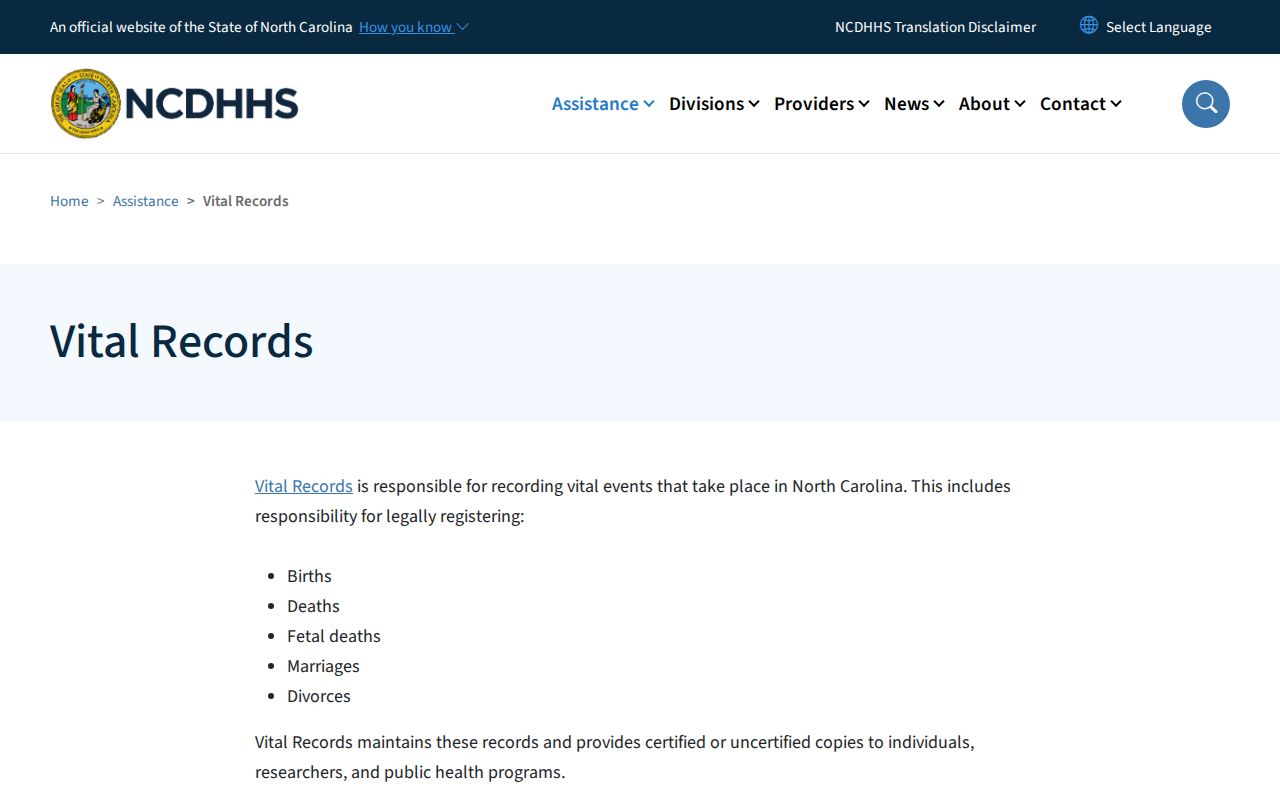
The state route is useful when the event county is unknown, while a known Wake event may be handled through the Register.
Browse Cary Voter Records
The NCSBE Voter Search asks for first and last name, then allows a middle initial, birth year and county. At least one status must be selected. A profile may show status, party, registration date, precinct, districts, polling place, sample ballot links and participation history. It never shows marked ballot choices.
Most Cary voters are administered by Wake County. The profile's county and municipality fields can identify a Chatham-side record. North Carolina also publishes free weekly county and statewide voter files, with public addresses, status and districts but without birth dates, Social Security numbers or driver-license numbers. Full voter treatment belongs on the Cary voter registration records page.
Find Cary Business Records
Entity-owned property calls for a second name search. The North Carolina Secretary of State's business registry can reveal the legal entity name, status, formation date, registered agent, office addresses, annual-report officials and filed documents. Open each dated filing before assuming that a person still holds the stated role.
Assumed names filed on or after December 1, 2017 are in a statewide search. Older assumed names must be checked with the Register of Deeds where they were filed. Professional licenses are split among separate North Carolina boards, so preserve the board-issued license number and status date.
Map Cary Address Records
A postal city is not a legal jurisdiction. Cary contains primary and satellite annexations, unincorporated pockets and parcels across three counties. The Wake County and Raleigh iMAPS viewer accepts an address, street, owner, PIN or REID. It can display parcel identity, government layers and links to real-estate or deed data.
If an exact address fails, try the street alone, directional abbreviations or a map selection. Cary's open annexation data can then explain when a tract entered town limits and who petitioned. A map boundary is useful government evidence, but it is not a survey.
Lawful use. Use Cary address and people records for legitimate personal research. Public access never permits stalking, threats, harassment or attempts to defeat protected-address rules.
Search Cary Family Archives
Olivia Raney Local History Library is Wake County's main noncirculating local-history branch. Its catalog lists suburban and reverse directories for scattered years from 1986 through 2024. A standard directory moves from surname to address. A reverse directory moves from address to a listed occupant, who may differ from the deed owner or tax-mail recipient.
The library also holds 2.5 linear feet of Cary News clippings from August 31, 1991 through December 31, 1998. Births, marriages, anniversaries, deaths and other family items make that collection a strong bridge for Cary's high-growth years. Search the catalog by surname, subject and collection, then plan for onsite use when an item is noncirculating.
For older work, Wake County formed in 1771 from parts of Cumberland, Johnston and Orange counties. State Archives county guides, deed books, estates, census schedules, newspapers, cemetery registers and church material extend the search before Cary's 1871 incorporation.
Check Cary Offender Records
The North Carolina Department of Adult Correction search covers state prison, probation and parole information. It can return an offender number, aliases, status, sentence material and location or supervision data. The North Carolina SBI registry supports official name and geographic searches. A registry or custody entry should be checked against the court disposition because an arrest, charge and conviction are different events.
The North Carolina offender registry supplies a public protection search with explicit limits on intimidation and harassment.
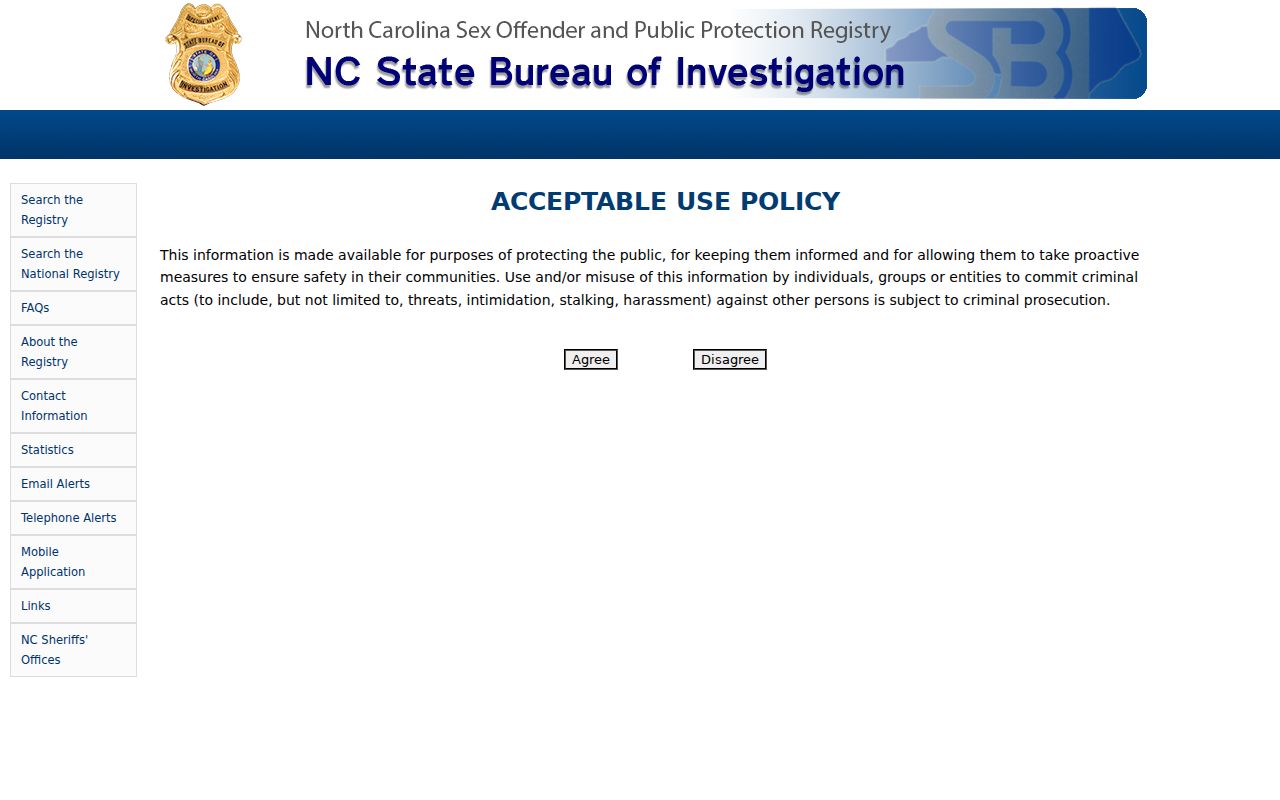
The captured state portal is a name or location starting point, while the sheriff and court file remain the verification channels.
Wake Sheriff publication practices were set to change in August 2026 after concerns that separate mugshot and daily arrest pages did not receive expunction updates. Even if proactive web pages disappear, releasable arrest facts, sheriff requests and eCourts remain distinct routes.
Search Cary Unclaimed Records
A former Cary address can lead to property reported to the State Treasurer. The official NC Cash search uses an owner name and supports the state's claim process. It can be useful when a person has moved or an estate has unresolved funds. A possible match is not proof until the state verifies the claim.
The North Carolina unclaimed property portal is shown below.
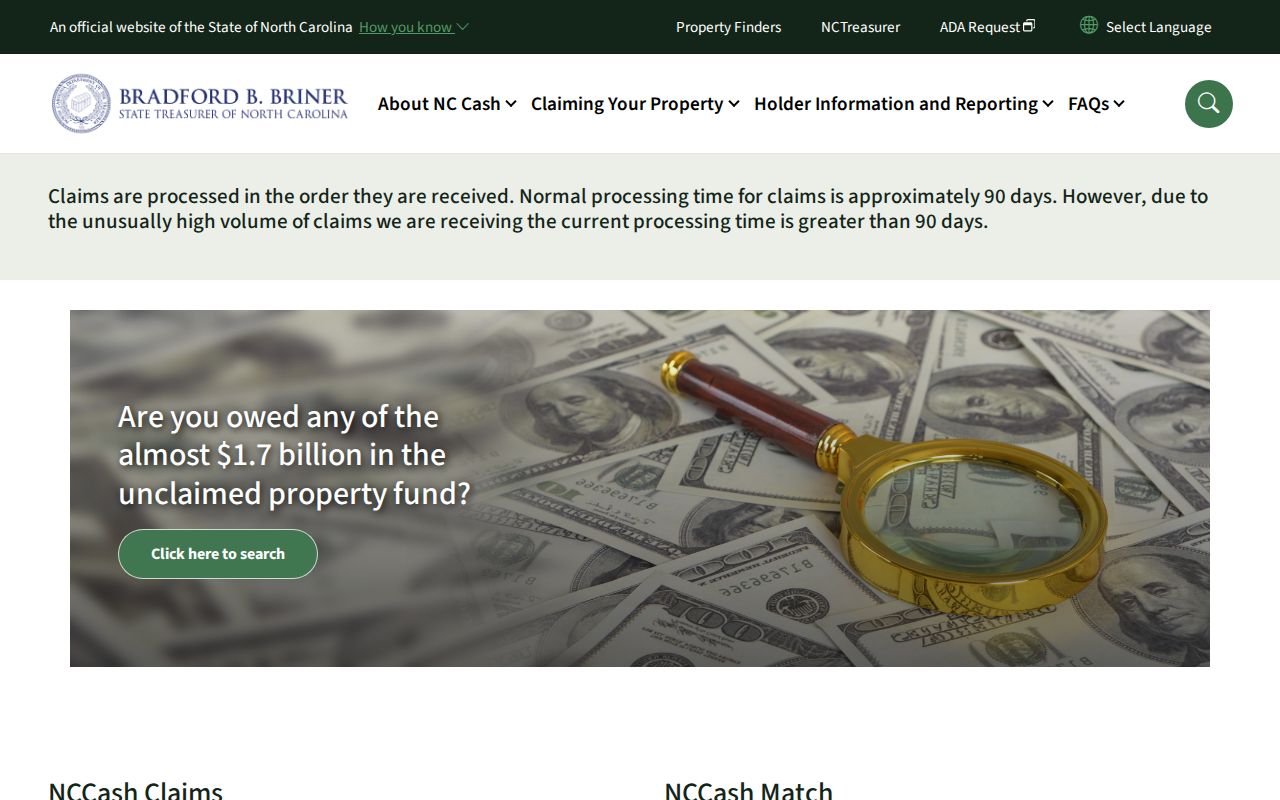
The official search avoids advance-fee pitches and keeps the claim tied to the state program that holds the property.
Verify Cary Search Results
Official indexes and commercial compilations do different work. A compilation can combine phone, address and relative leads, but it may merge namesakes or keep an old address. An official portal identifies its custodian, record date and stable number. Neither should be treated as proof until the underlying record and date are checked.
| Source type | Strength | Main limit |
|---|---|---|
| Official index | Named custodian and record identifier | May omit images or protected fields |
| Underlying record | Full filed context and party roles | May require a clerk, fee or eligibility |
| Commercial compilation | Broad lead gathering | Stale, merged or unclear provenance |
Use two independent attributes before joining results. A middle initial, parcel number, case number, license number, county and approximate year are stronger than a shared name and city. Dates matter because a staff role, voter status, parcel owner or court event can change after an index is captured.
Save the source, record number and retrieval date. Then compare the result with the issuing office or the underlying image. If two records disagree, determine whether one reflects a later event, a mailing address rather than a situs address, or a namesake. If the evidence still conflicts, leave the identity unresolved.